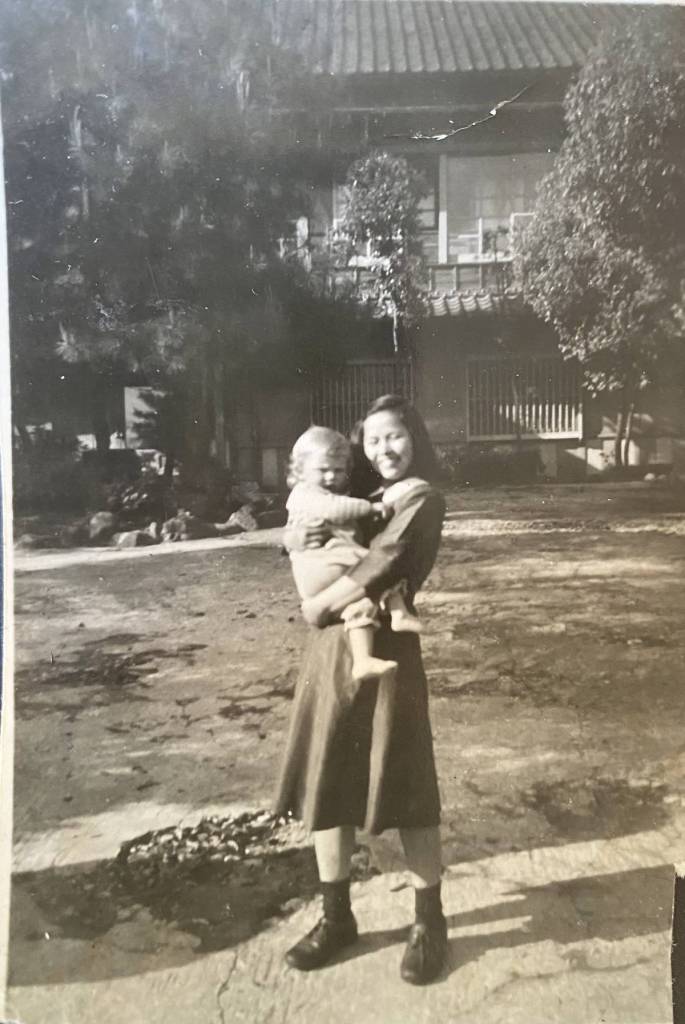
– this young lady might be Yoko-san mentioned in this post.
Milton:
We were so poor in Kokura city that once when my mother sent a book to me, she rushed it over, using Air Freight which turned out to be more expensive than regular Air Mail. I could not pay the delivery fee. June talked to the man at the front door while I slipped out the backdoor and sold our clock to the nearby repairman. But we settled in and learned to live simply. June cooked on clay charcoal burners in the open and shopped for bamboo shoots and seaweed in the back street markets.
June:
At Kokura we lived in two rooms of a small Japanese style inn or hotel with paper doors between the rooms. There was also a Japanese family renting in the same hotel. This was in 1949 and nobody had money or time to stay for a holiday in a Japanese inn in those days. There was a large kitchen that we shared with the Japanese family with no gas or electricity in it. Cooking was done using a shichirin, a sort of small grill where charcoal was burned to give heat. There was no heating in the rooms, but we could warm our hands over another charcoal heated pot called a hibachi. But we were young and got used to the cold. I was 22 and Milton was 30.
Mary: Notes from Dad’s daily dairy are a reminder that this truly was post-war Japan, under U.S. military occupation. April 13th, 1949 he wrote: “Saw the city authorities re rations also visited Camp Kokura and saw Captain Smith. Was invited to service on Friday night.” The comment about rations led me to research and learn something particularly about ramen that was new to me. During the war the Japanese government had been rationing food due to severe shortages and then after the war, the US occupation had the Japanese continue to run the rationing. Because the previous war years had led to dismal rice harvests, the US imported vast amounts of wheat to Japan to help with food supply. And this is when the popularity of ramen really took off because the noodles were made from wheat flour. Also, the Japanese people could not live only on the rations, so black market ramen stands started popping up.
Milton:
Kokura was a good training ground in many ways. One of them was language practice. We had to use Japanese and at that point I had precious little. One day our old radio died on us. I took it to the local repairman and tried to have a conversation with him. He asked me in return if I could teach him English. At that point I felt I was in a race to desperately fill my head with Japanese and didn’t think I would have time to teach him. So, I wanted to stress to him that I was extremely busy. The Japanese word for “busy” is “isogashii” and the word for beautiful is “utsukushii”. On paper these two words do not look alike but were easy to interchange in the linguistic darkness I walked in. I wanted to make my meaning clear so I used the word meaning “very” with emphasis. I said in a clear voice: “I am sorry, but I am VERY beautiful (utsukushii). The man behind the counter didn’t blink. He looked me right in the eye and said, “Yes, that is true.” I left the shop and pedaled back towards our broken-down hotel. As my legs picked up speed, my mind ticked over ‘utsukushii – isogashii – utsukushii”. The truth dawned on me. I walked into the house and told June about my mistake. “Rush back and explain” she pleaded through her laughter. I said that if he cared to think I am beautiful, I think that is a very nice way to think. Why spoil it for him??
Milton:
A Japanese couple lived in a couple of the rooms in the hotel also. They used the large kitchen to cook and we set up our cooking things in what had been a washroom. The front entrance of the hotel was shuttered and we all entered through the side kitchen door. One day June stepped in and saw a cat spring up onto the sink and sniff a plate of fish. She didn’t know if the fish had been put there for the cat or not.
June:
One day I went into our common kitchen that we shared and saw their cat eating a fish. I thought, “Maybe Japanese people feed fish to their cats.” I thought carefully working through the grammar but called out, “Neko wa… sakana wo….”(The cat… the fish)” My neighbor let out a scream before I could finish the sentence and ran to the kitchen but it was too late. The cat ate their fish for dinner with no apology.
Milton
While in Kokura, I had been asked to preach at the Chapel on the military base and to the prisoners in the stockade. Some of the fellows came to the Lord with tears in that place. After that the Ashiya Air Force base further out sent a jeep for me each Sunday while they were waiting for their next Chaplain. The Division Chaplain suggested I ought to go to the USA and share our testimony of the Lord’s care. I stored that thought in my mind. I said: “When the Lord sends me, I’ll go.”
June:
One day we had a Japanese visitor who spoke English. He invited Milton to teach English at his college which was next door to our hotel. In exchange the college would provide us with a teacher who would teach us the Japanese language. Milton only taught English a couple of times a week and we had free tuition in Japanese from an expert teacher. It amazed us how God supplied our needs.
Mary: Another interesting diary notation was on April 28th: “Money from Tokyo arrived – perfectly timed to give us the advantage of the new yen value. I bought some apples and posted some letters”. Up to that point the yen value had been very unstable (as you may remember from a previous blog post where June & Milton delayed their trip to Kyushu due to the expected change) On April 25th, 1949 the U.S. Occupation forces fixed the yen value to 360 yen to $1 (one) dollar; where it remained until 1971. Also on May 22nd: “Preach at Ashiya again…. Mrs. P gave me much of her left-over food etc. as she was leaving for the USA. One tin of corn syrup is good for Stanley’s drink until the honey arrives.” The comment about waiting for a shipment of honey will mean nothing to anyone but my siblings – even decades later when we lived in a much more modern environment in Tokyo, Dad ordered honey in bulk quantities. I now see this was something he started to do way back in 1949.
Also, during this time in Kokura, they found a nanny/maid to take care of Stan at times when they both were to go to a meeting or perhaps study. Her name was Yoko-san. June 5th, 1949 “Yoko san took Stanley, and we went to the Baptist school service and then took Dr. Morotomo to the evening service at the Kokura Baptist Church”
Milton:
We didn’t stay in Kokura for long. The Southern Baptists were doing marvelous and extensive work in this city. We felt there must be some place more needy for little people like us. June asked a veteran born-in-Japan missionary, what part of Kyushu he considered lacking in mission work. He replied without hesitation: “Ohita Province” We started packing.
Mary: According to his notes, by July 1949 the three of them spent a day taking a train to Beppu city (in Ohita) to start looking for a place to live. Then on July 21 “Teachers continue to call each day although it is their vacation time. We will need teachers at Beppu and are looking to see how God will provide. Received parcel from Burwood – soap and water bottle etc. “(Burwood was the Sydney suburb, where Milton’s parents lived.) I thought this single comment on August 30, 1949 was pretty cute: “Yoko san gave Stanley big duck”
By the end of September 1949 June, Milton and Stan would move to Beppu – a place with more stories so stay tuned!

 From the Land Down Under to the Rising Sun