I have gone down a rabbit hole of posts about Milton’s grand-uncle, James Whan in this blog devoted to June and Milton Wayne; so forgive me. But, we have such a fascinating record of life in the late 1800s via James’ letters. I am compelled to spend one more short post about James.
To recap from the previous post, James Whan has sailed to Scotland to see his family. He says goodbye to his parents for what he suspects will be the last time. Once again, he boards the S. S. John Elder to return to his wife and children in Australia. This time the ship sails around the Cape of Africa rather than through the Suez Canal. The following sounds like letters but I believe it is more of a journal to his wife because if he were to send a letter, how it would get to Australia is by the S.S. John Elder!
His description when they first left England:
Left Plymouth at 1 pm on 30th April. The weather is very cold and by nighttime, there were lines of sickness. On the morning May 1st. Seemed very gloomy to some, nearly everyone sick, some very bad, wishing they were on land again as J Elder was cutting her way through the ruffled waters. What pleased me so, I would soon be where I started from, that is back to you. So, we got through the much-feared Bay of Biscay with fair weather although some thought it bad. Cleared land at 1 pm on May 2nd.
May 3rd. Passengers recovering today, and the weather is delightful, and the fair sex is beginning to smile again.
I thought it was so sweet that while he was sad to leave his family, he was looking ahead to reuniting with his wife Elizabeth. Awwww.
And here’s a little too much information from James about being sick:
May 4th Was bad in my bowels this morning for half an hour. Sweat came pouring out of me; thanks to my Heavenly Father it did not last long or you, my dear one, would not have had my presence among you again. The weather is delightful today, all seem to enjoy themselves very much, having recovered from their sea sickness.
I chuckled at his assessment of the food:
There were twelve bullocks shipped, prime beef, and all are slaughtered but one. The potatoes are very bad this trip, which does not suit me very well. They are beginning to rot and quite bitter, but the bread is as good as ever, first class. He is a first-class baker, perhaps because he is a Scotchman.
James may have moved to Australia, but he still had that Scottish loyalty!
This next entry points out that the journey can be perilous:
May 11th. Crossed the line today [pretty sure that’s the Equator] and I am glad to say the weather is not so warm, the wind being stronger. There are, however, a few sick people, in our berth, a young man going to seek his fortune, but not seriously ill. Crossed the line at 12 o’clock. The weather is not so hot as there is a headwind, a good breeze which was much needed where there are so many passengers as some of them would not have lived through it much longer, but I don’t think it was as warm as when we came through the Red Sea. We have had headwinds ever since May 9th. Southwest trades and expect to carry them to the Cape which we hope to reach by the next Lord’s Day if all goes well.
By looking for newspaper records, I found that the John Elder arrived in Adelaide on June 11th and then on to Melbourne. As it mentions, the arrival of the ship meant arrival of news from England for those in Australia.
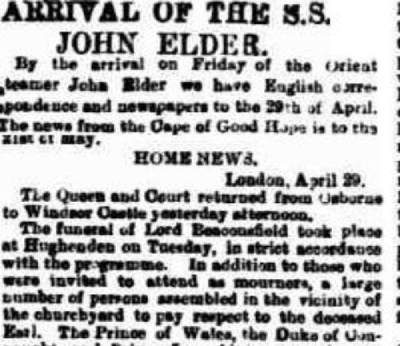
The ship then called into Melbourne, it is not clear if it then sailed up to Sydney or if James had to make his way by land back home. Nevertheless, he was reunited with his family at some point in June, having been away since the end of March.
Just over a year after James’ return his wife Elizabeth Holland (Morehead) Whan gave birth to their fifth child. Their son Andrew was born on July 23rd, and tragically Elizabeth died from what must have been complications from the birth on August 9th. With the dates so close it would be safe to assume there must have been complications from childbirth.
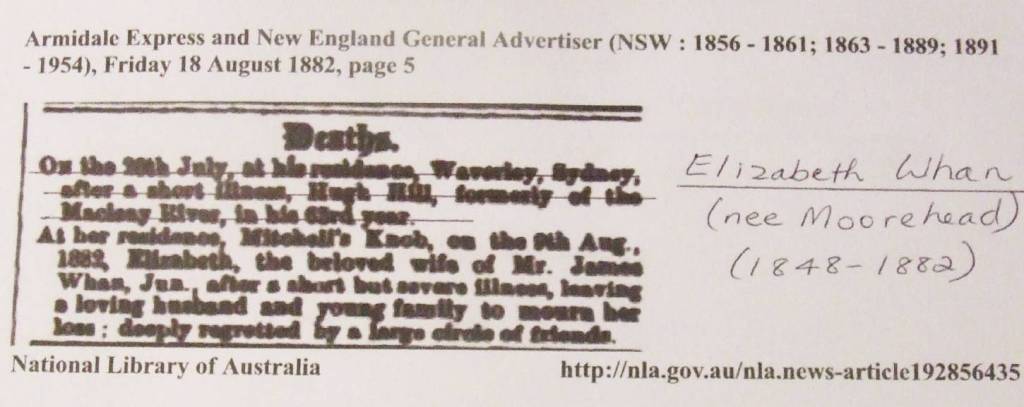
Less than a year later, James now a widower with five very young children marries Anna Maria Rutherford on May 23, 1883. Like his first wife, Elizabeth, Anna is also from Ireland.
James and his second wife, Anna then proceed to have 11 children!! Let’s just say there are plenty of Whan’s in Australia, particularly coming from the Armidale area.
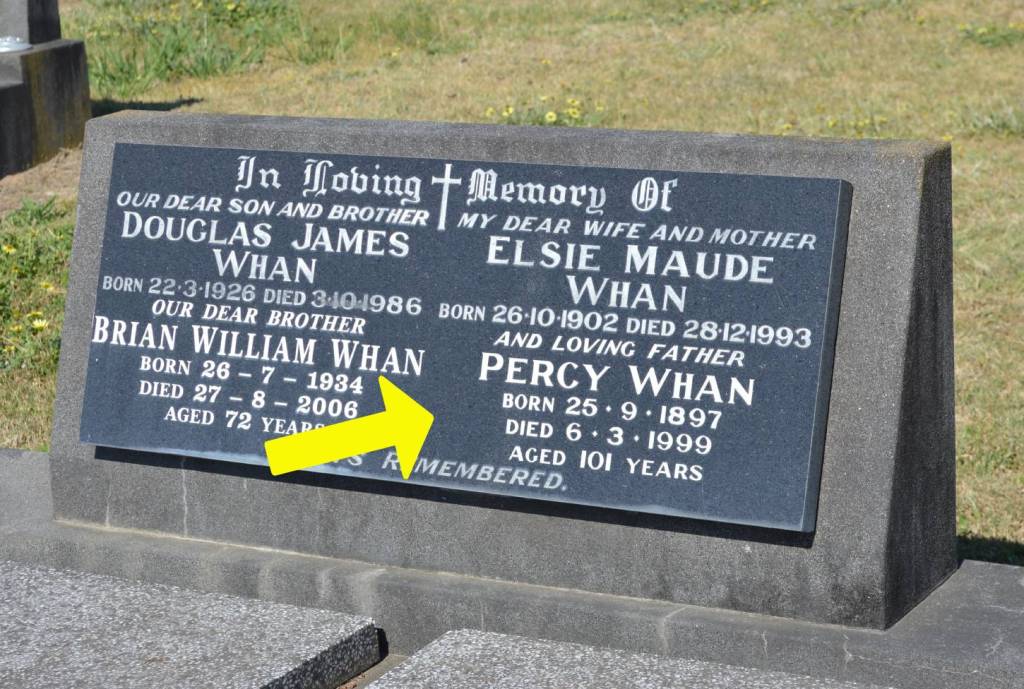
Fast forward in time, the last of James’ 16 children to die was his son Percy. Percy passed away in 1999. He was 101 years old! I am bummed I didn’t know this earlier in my life. Milton’s link to Percy would have been 1st cousin once removed – Dad’s father Matthew and Percy would be 1st cousins. On Ancestry, I have distant DNA links to 5 ancestors of my great-granduncle James.
That wraps up my deep dive into Great granduncle James.
In 1885, James’s parents Matthew Whan and Janet Cameron Whan move to Australia with their youngest daughter. Mary, the daughter is 24 years old at the time. This must have been a happy time for those already in Australia including James’ brother Andrew – Milton’s grandfather.
Just to remind you of the direct line:
Matthew Whan (born in Scotland) is Milton’s Great Grandfather 1824-1900
Andrew Whan is son #4 also born in Scotland and moves in 1880 He is Milton’s grandfather (1852 – 1943)
Matthew Whan (1883 – 1960) This Matthew is Milton’s father. He is the one who started a construction business in Fiji.
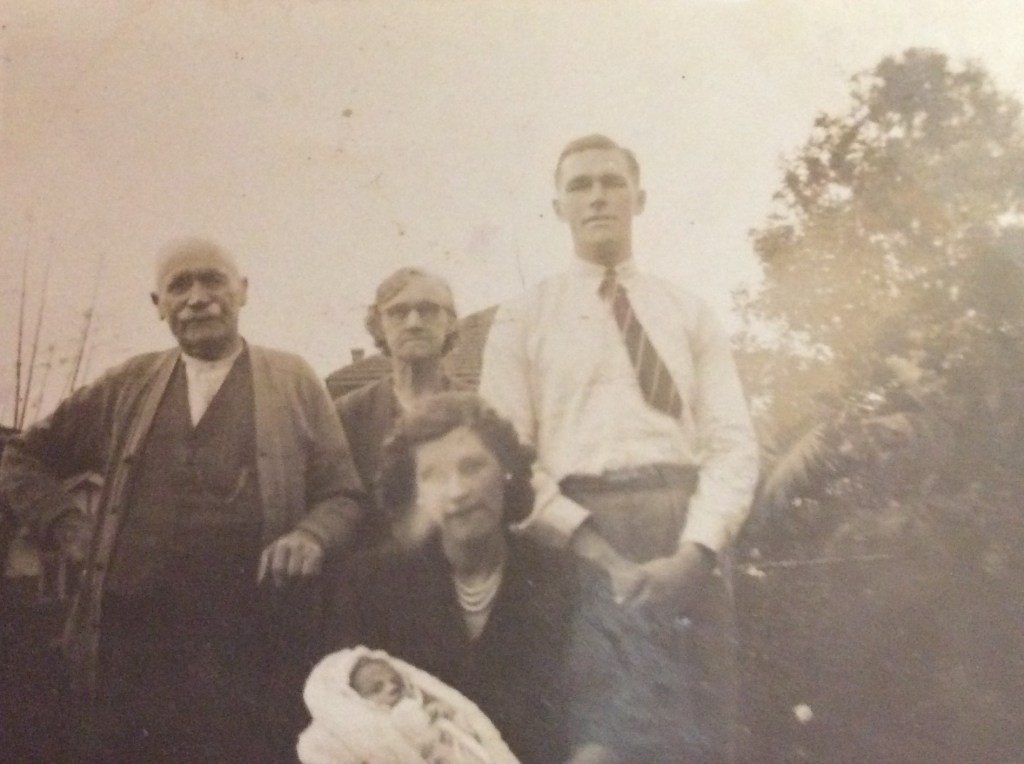
Next post I will share letters from Matthew Whan (1824-1900) to his brother in Canada. If I mention that his brother’s name is Andrew – the same as his son’s name, you shouldn’t be surprised. For a little more Ancestry geek “stuff” here is a list of traditional Scottish naming conventions that may explain the repeated James, Matthew and Andrews in the Whan line. Not everyone followed this particularly Milton’s father seemed to have broken the cycle. (Source was several family history type websites)
The traditional patterns used when naming Scottish boys were as follows:
- The family’s first son was named after his paternal grandfather
- The second son was named after his maternal grandfather
- The third son was usually named after his father
Scottish girls’ naming patterns
- The family’s first daughter was named after her maternal grandmother
- The second daughter was named after the paternal grandmother
- The third daughter of the family was named after her mother
 From the Land Down Under to the Rising Sun