Long time since my last post but I actually have another story Milton wrote. It’s from the very early years when June and Milton lived in Beppu. Both Mom and Dad chronicled it in their autobiographies, so I know it was significant to them. But interestingly, Dad made this story a whole separate chapter. The way it was written, I came to the conclusion that he submitted it to a magazine.
I remember him writing for Guideposts Magazine probably in very early 1970’s and I recall he proudly got published. Not only for something under his own byline but he also got paid small sums of money for the occasional ghost writing he did. Rummaging through some old stuff, I came across a certificate from a writing course Milton took, which further cemented my theory that the following story was written for publication.

Maybe it got published, maybe not so perhaps for the first time here it is. The story Ichiro Yoshida and a coat. I lack pictures for the more visual people (I added two at the end) and it’s a bit long. (10 minute read) but grab a cup of coffee and a comfortable chair.
For our first Christmas in Beppu, we asked the city office if they would send fifty of the poorest people in the town and we would provide a Christmas dinner for them. It was only a token, and it probably gave us more joy than our guests. After that, we discovered far more desperate people living under bridges and in abandoned bomb shelters, dug into the cliffs. The walls oozed moisture and the floors were wet. The fittings of the homes were made from old boxes and bags. Children starved and barefooted came to greet us, and their clothes were mud-soiled and tattered. When gift parcels arrived from home, we took the contents to the suffering people and went home to cry.
One of those parcels contained a sheepskin-lined winter coat that would keep an anemic Siberian warm. We saw snow around us on the hills and the nights were cold in our rattling windowed house. I had even worn a wind cap and gloves to bed. But when June saw the coat, she immediately thought of Ichiro Yoshida up in the even colder mountains.
Young Yoshida had been repatriated from Manchuria at the end of the war. He was one of the millions of Japanese who had previously settled in China but were required to go back to Japan. How Japan’s little islands absorbed the avalanche of displaced people flooding back from the deflated empire, mystified me. Japan already had seventy million people living in an area no bigger than Oregon – if you discounted the mountainous regions unfit for habitation. Now another three million came, needing living space. Japan accommodated them and still prospered. But there were tragedies and Ichiro Yoshida was one.
When an official checked his name, he noticed Ichiro had a father living in Kyushu, so he was assigned to that address. Yoshida had been away for years, trained as an engineer and living in the big cities of Japan’s occupational frontiers. But after hours of travel, he found himself at a station in the mountains of Oita province and felt the wind tingle across his face.
“Looks like a Manchurian village,” he muttered to himself, “there won’t be much work for me here. I’ll ship out in a week or so.”
He wandered over to the police box on the corner. Two officers were standing over a charcoal burner staring at a kettle ready to have some tea. They both looked a bit tattered. But then Ichiro looked down at his own clothes. After the long ride on the steam train his clothes smelled like coal smoke. He took out his handkerchief and wiped his face.
Yoshida bowed politely as he entered and asked them if they knew the direction of his father’s house.
“Looks as if it must be about here”, he said pointing to a spot. It’s north of here.”
“How do I get there?”
“Three buses are running up there, but one is broken, another one is in bad shape. It will only go part of the way up because it is too risky in the steep parts. That one leaves in 15 minutes in front of the post office over there. Or you can wait for an hour and get the next one that will take you right up to your hamlet.
“Thank you, sir, I am much obliged.” Ichiro snapped his feet together and bowed low.
“Don’t mention it” the officer laughed. “Those bowing, scraping days are gone.”
Ichiro headed across the street. In talking to the shopkeeper of the tobacco shop he was told if he caught the first bus that would leave in 15 minutes, it would only take a few minutes to walk up the hill to where his father lived. He ducked into the noodle shop next door and was able to gulp down scalding noodles before catching the bus.
It wasn’t crowded and he chose a seat by the window. He watched the sun glittering through the bamboo leaves as they traveled. He saw thatched houses with green gardens, farmers pulling carts along narrow lanes, and clear water running between the fields. The red autumn leaves created a scene as if on an artist’s canvas. But it was all lost on Ichiro. He longed for the smell of sump oil, glittering neon lights, and the big city. The higher the bus bumped and climbed, the houses became more space and he felt depressed.
The next stop is the last one” the driver announced. “Don’t forget anything and take care of the step on the way out. Thank you.”
Yoshida lifted his knapsack and tattered bag off the rack and stepped off the bus behind several women. They all had huge empty wicker baskets strung across their backs and were happily chatting. He thought maybe someone would know his father.
“Have you been to the village market selling vegetables?” he asked.
“The ladies looked at each other and roared with laughter.
“Not the village market – the city black market. And not vegetables but rice,” she explained.
“You are new here. Do you come from Honshu? Your accent is different,” another lady noted.
“I am from Manchuria. I was repatriated last week.” Yoshida explained.
“You are one more reason why we must deal in the black market. We are flooded with refugees,” one lady almost spat out.
“I am sorry. I wanted to stay there. I lost everything.” Yoshida apologized and looked down at his feet.
“I didn’t mean you, personally, the lady’s voice softened. “You have suffered more than we have. It’s all too bad. Can’t be helped” she finished with a shrug of her shoulders.
“Do you know Taroo Yoshida?” he asked the group.
“Oh yes.” The first lady replied brightly, “he lives straight up the road. Up on that high hill on the right.”
“You can’t miss the house. It will take you twenty minutes to walk there” another lady offered. Then a new thought lit her eyes.
“Are you, his son?
“Yes, I am” he answered.
After that, the ladies clustered around him and asked him questions while they walked and then one by one took off along the paths between the rice paddies toward their own homes. Soon Yoshida was on his own. The sun was blocked by the hill and the wind picked up. He pulled his coat tight around his neck and walked faster.
“It won’t be long,” he thought looking around. “I will get out of here in a hurry. There must be a machine somewhere that needs me.”
He got to the door of his father’s house. His mother had died shortly after his father moved to this farm at the beginning of the war. He hadn’t seen his family in 15 years. He often thought of how lonely his father must be but he had not imaged it would be as isolated as this. No one answered when he called out. He could hear a radio blaring out the names of missing people. Then it quieted as he heard someone unlocking the front door. As it rattled open, he saw his old father.
“I have returned” he announced and bowed.
The old man stood still in the doorway and didn’t move for a moment. His eyes searched with intensity and then a tear formed. He stepped back into the entrance and said with a slight bow.
“You have returned. It is good. Very good. Come, come inside.” He put his hand out to take bags.
“It is too heavy for you” Ichiro smiled at his father as he kept his grip on both the knapsack and the suitcase. He slipped off his shoes and stepped up into the house.
They went into the next room where his father put two small cups on the low table. He took a kettle from the charcoal burner that he also used to heat the room and poured water into a teapot.
“I was listening for your name on the radio,” he said as he poured.
“You didn’t get my letter?”
“Not yet. It will come. The mail takes a long time now. Our country is devastated. Almost destroyed. We are lucky to have food here.”
“It will rise again” Ichiro answered quickly,’ it will rise from the cities.”
“People are dying in the cities. We must keep our people alive from the soil. It is our duty.” The father said seriously.
Ichiro watched his father’s rough wrinkled hands hold the hot cup as he spoke. Memories of his youth drifted into his mind. He decided not to mention his desire to get a job in the nearest city. They talked into the night and his father brought out the precious sake wine he had been keeping for this day of celebration.
The next day, Ichiro followed his father into the fields and had the first of many lessons in farming. He worked hard, hoping his efforts would help feed the starving people down in the city, but he hated every moment. The winter came and so did the snow and ice. Meat and green vegetables disappeared from the diet. Even dried fish was hard to come by. Ichiro never saw a machine, let alone repair one.
“This place will kill me,” he groaned as he trudged back from the tool shed one evening. He coughed as the icy air hit his lungs.
He and his father discussed the future and Ichiro told him of his training in engineering and his desire to go to the city.
“I’ll send back money,” he promised. But they didn’t even have enough to hold him over while he looked for work, so he stayed on farming. He hoped by the spring there would be a bumper crop to help.
During the second winter, he developed a cough that wouldn’t get better. He stayed in bed for a few weeks and his father cared for him. The hope of life in the city was slipping further away. He was weak and often had pain in the chest. He got better in the spring but by the next autumn he was sick again and coughed up blood. His clothes hung like bags on scarecrows. He cursed the world and his father and then he coughed again. So, his father escorted him to Beppu City where there were many sanitoriums.
Ichiro was lying in a long public ward when we met him. We visited the hospital to sing to the patients and talk and pray with anyone interested. That summer he was able to walk around the hospital grounds in the afternoons and sometimes I would find him under a tree, and we would talk. But he was too bitter to enjoy thoughts of heaven, though he liked the singing he said. One day as we talked again, he confessed that he was a bitter sinner and as he looked up to the beautiful mountains, he came to believe in the existence of a creator.
Soon he was released from the sanitorium. He wasn’t healed, but he was able to walk and that was better than the long list of other patients waiting to come in. He went back to his father’s farm.
That was when we sent the extra warm coat to Ichiro because it was so cold up in the mountains of Kyushu. A week later he walked into the entrance of our house. He had come to thank us for the gift. We were dumbfounded. The cost of the journey must have put a big hole in their budget. I wanted to continue the discussions from before but felt it was the wrong time to deliver a sermon. It would look like we were using the gift to hammer home the doctrine of our faith. We talked about everyday things until he was ready to head home.
I wanted so badly to help him out of his perpetual gloom that was destroying his lungs as much as the lack of protein was. As we walked towards the bus stop, I tried once more to tell him of God’s love.
“I don’t understand Christian theology,” he countered.
“I’m not talking about theology at this moment. I am talking about life and peace. You have admitted you are a sinner.”
“I know I am that is the problem maybe,” he gave a short laugh.
“You believe in God the creator, right?”
“Right”
“Then Jesus is waiting to save you. It says in the Bible that as many as receive Him get to be the children of God. It promises that ‘whosoever calls on the name of the Lord shall be saved’,” I continued.
We turned the corner and people were already waiting in line at the bus stop.
“I think the bus is coming,” he said, “it’s my last connecting one. I will run.”
He moved ahead of us as the bus came into view. I called to him:
“Yoshida-San tonight, kneel by your mattress and call on the Lord. Ask Jesus into your heart.”
He looked back and said he would and with a wave, he jumped onto the waiting bus and was gone.
Soon after that, we received a letter from him. He told us of a wonderful experience. He had knelt on the floor by his sleeping quilt and talked to Jesus. A most wonderful peace came over him and he knew he was saved. Then a few weeks later another letter came saying he was sick again but had been accepted at a smaller hospital not far from our home. We were saddened that he was suffering but glad that we would be able to see him again. We could teach him more about Jesus and Christian living.
While visiting another patient at that hospital one day, I dropped into the office to find out the exact date of his arrival. I wanted to be there to welcome him. The man behind the glass window walked over to a desk and began checking through a book. He stopped reading, shut the book, and walked back to me.
“He should have arrived today,” he said,” but he died. He is dead,” he repeated.
I excused myself and left the hospital. I wandered through the beautiful maple forest and to the rocky riverbed near our place. I walked over the bridge and looked down on our small, red-tiled cottage with the low garden wall made from stones taken from the river. Yoshida-san would never come through the gate and study the Bible. But he didn’t need instruction about Christian living anymore. He knew more about Jesus now than I could ever tell him.
June suggested we write to his father and express our sympathy and our hope. Later a reply came. It was written with a fine brush and charcoal ink on soft rice paper. The old polite way of communicating.
“I have seen men die before,” he wrote, “some fearful and some resigned and brave. But until the death of my son, I have never seen anyone smile in death. Ichiro had such peace. He talked to me about Jesus Christ. At the last, he seemed completely content and then he looked up as if he saw something, and he smiled. At that moment, he went. I am an old man now and I would love to be able to face death with a smile. May I visit you and find out about Jesus and this heavenly peace?”
So, he came to see us. The old farmer who had worked alone up in the cold mountains to help feed his starving brothers, the father who waited for his son and who nursed him through his bitterness and his illness. We told old Mr. Yoshida about the Lord and about the Cross. And he prayed with us for forgiveness and asked Jesus to be his Savior. Then he returned to his home in the mountains with a new faith.
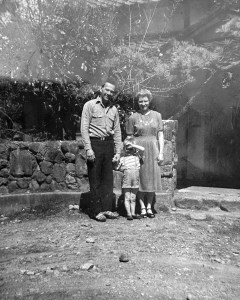
Milton, June and Stan in front of what I am quite sure is the low garden wall Milton mentions towards the end of the story.

Postcard from Beppu in the 1950’s (I think). My guess is the cold mountains where Yoshida-san came down from are those in the background.
 From the Land Down Under to the Rising Sun
Wow. It’s a poignant story. Dad wrote this? I hope that Yoshida-san really did die in peace. We, today, have so much in health care, food and wealth, we take things for granted, as I think Japanese did until they lost it all in the war. It’s hard to imagine the suffering Japan and so many people have gone thru, due to war. But Japan is wealthy today. God is good.
LikeLike