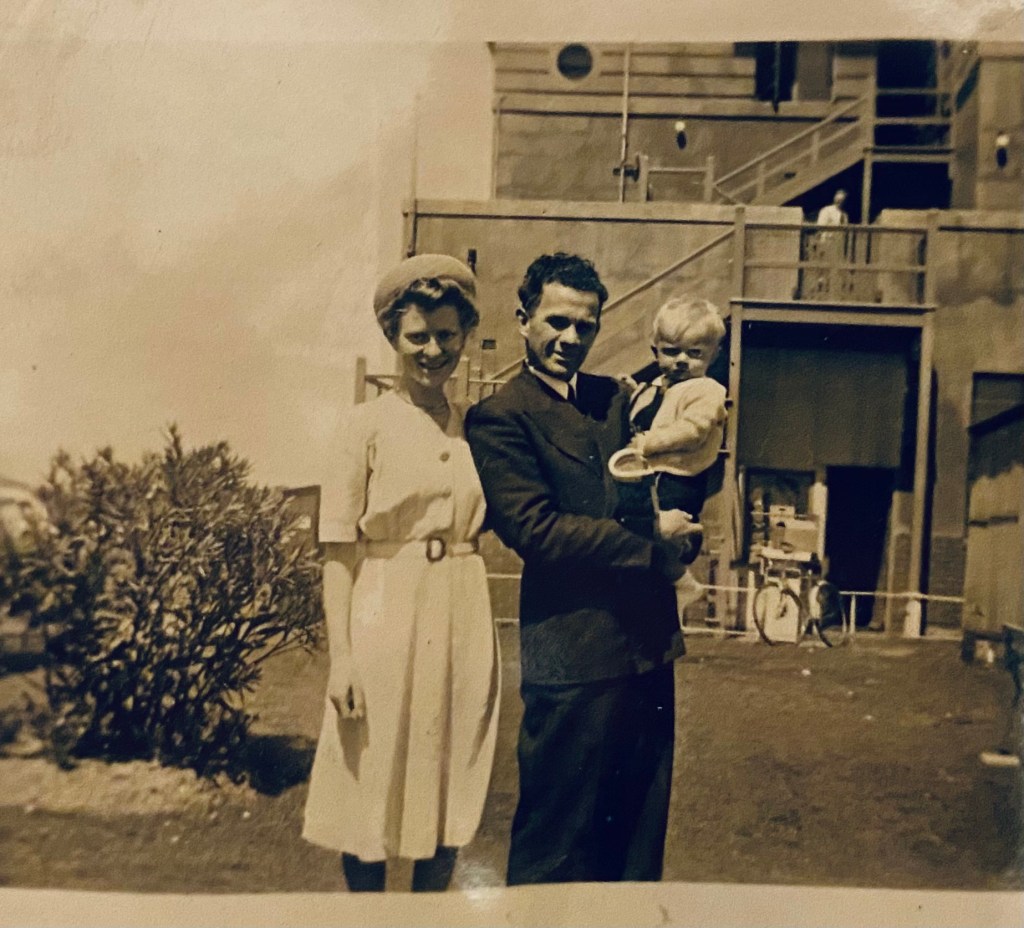
June & Milton’s missionary stories are full of answers to prayer. Their December 1948 voyage to Japan is a prime example. They both wrote about this event in detail. Dad titled that chapter “Hello Adventure” with a subtitle ‘Feeling the mystic power of God’. Mom titled her chapter “Our Big Box”, The two seemingly disparate titles make me chuckle because as you read the following accounts – it really was a Big Adventure that involved a Big Box. It was clearly something that impacted the very start of their journey – a leap of faith into their new life in Japan.
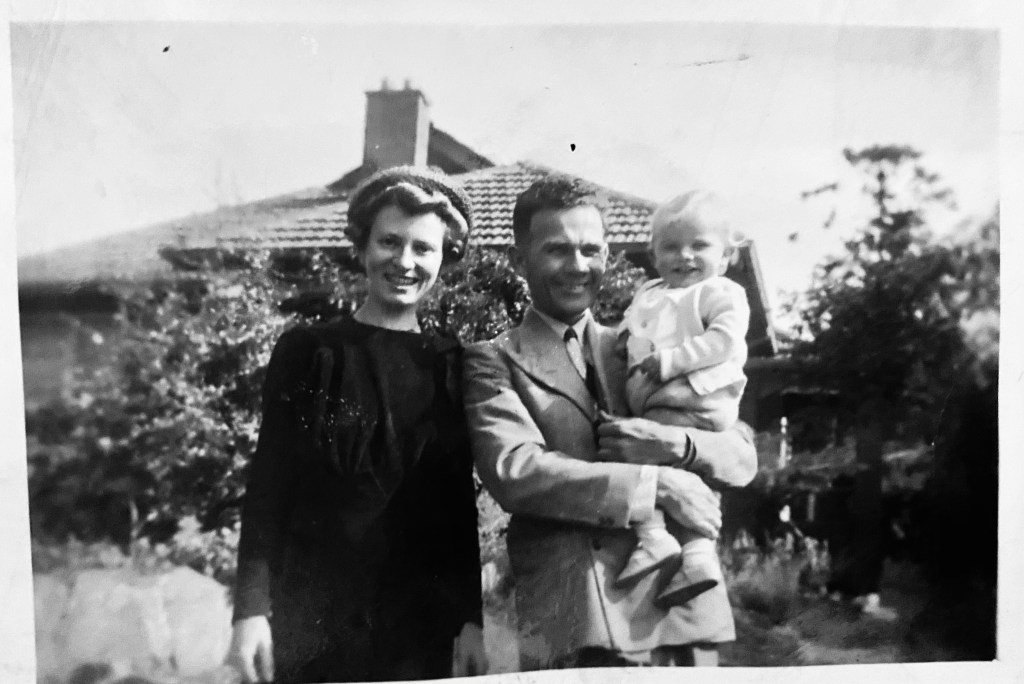
Just to set the scene, Mom and Dad were married at the end of 1946. Shortly after, General MacArthur put out an appeal for missionaries to come to Japan. (At the time, General Macarthur oversaw the post war occupation of Japan.) I once asked Mom, what was the reason they chose Japan as a destination for mission work, since during her younger years she imagined herself going somewhere even as remote as Tibet. She said the motivation came from the dropping of the atom bomb and its aftermath in 1945. They both make references to General MacArthur’s appeal in their writing but elsewhere Dad wrote about the decision earlier when they heard the news about Hiroshima. Once they got married, the next year, Stan came along in 1947 so they had to postpone travel. MacArthur’s rules were that babies had to be at least 12 months old to be approved for travel to Japan. So in 1948, when Stan was a year old, they had permission to go. Here is the story in their own words:
June:
Milton and I belonged to a small church. The leaders of the church said that they knew God had called us to Japan, but they could not support us financially. We were determined to go to Japan even without any guarantee of support and began to prepare. We wrote to an Irish missionary in Tokyo, named Bobby Wright, who promised to find us a place to live in Japan. We heard from another person that it was impossible to buy anything in Japan because the exchange rate for the yen was extremely high compared with our money. We were advised to bring one year’s supply of food, 5 years’ supply of clothing and soap. We were told to bring any furniture we would need as well. The funny part was that we were advised to put all our goods in one big box. It contained our household furniture, two bicycles, five years supply of soap, clothing and one year’s supply of food. It was before the age of containers, maybe the world’s first big box container. By the time we had bought all these supplies and paid our fare, we had no money left, except a few shillings.
Milton’s father paid to get the box from the Burwood house to the wharf, and friends brought gifts for us in paper bags, such as a teddy bear for Stanley, so we had seven paper bags as well as five suitcases that we kept in the cabin with us. A lady came and gave us five Australian pounds at the wharf. So, we said good-bye to family and friends and set sail for what we hoped would be Tokyo. The shipping agent in Sydney had told us it was too dangerous to announce the ship’s route and in what ports it would stop. They thought that the Japanese in those post-war times may have planted mines in the sea to sabotage the occupation forces of America and Australia. All we knew was that the ship was going to Japan and it usually went to the port of Yokohama, near the capital, Tokyo where Bobby Wright would meet us.
Milton:
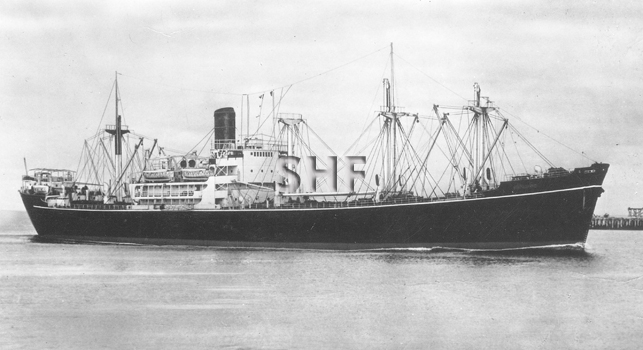
Early in December 1948, our old S.S. (steam ship) “Nellore” arrived in Japan, edging through the breakwaters of Kobe Harbor. The Japan we were entering was not luxurious. From what we could see from offshore, the city skyline bore the scars and roofless buildings from a bomb blasted city. At the time, all of the wharves were occupied by other vessels, so our ship anchored out in the bay. We were anxious to get our first close look at the country and the people of Japan. As we leaned on the railing a high-speed navy boat streaked across the bay. There was the sound of gunfire in the distance. The soldiers near us on the deck looked out to sea apprehensively. They talked about the Koreans wanting to attack their old enemy. Obviously, war still lingered in some hearts, but the evening stayed quiet.
Early the next morning the Captain called me over and explained that all shipping was under military control. While he had planned on calling in at Yokohama before the return to Australia, he did not have S.C.A.P. (Supreme Commander of the Allied Powers) clearance and couldn’t go. That meant that although we had purchased tickets for Yokohama, we would have to disembark in Kobe. Suddenly the shores of the city looked cold. We did not have enough money to pay for even a night’s lodging once off the ship. Our only contact in Japan, Bobby Wright, who had rented two rooms for us was up in Tokyo. He was not obligated to help us where we were at that moment.
June:
In those days, the city of Kobe was 10½ hours by train from Yokohama which is the port for Tokyo. But the shipping company in Sydney had said they could only guarantee that the ship would go to Japan, not a specific city. We had no money. We had spent all our money on buying a year’s supply of food and 5 years supply of soap and clothing. We had our baby with us. We had five suitcases and gifts in seven paper bags given us by friends at the wharf. Worst of all we had this big container box. We realized that even if we had the money to pay for it, the box was probably too wide to fit on a Japanese train. We had no money for a hotel. We had less than a pound of Australian money and no Japanese money. Bobby Wright had no telephone. Very few people had a telephone in war-torn Japan.
Milton:
We could not speak the language and had no idea what we would do. I walked along the deck and saw the workmen already off-loading goods around our huge crate onto barges. June and I talked, and she headed straight to our cabin to pray.
June:
I went to the cabin to pray. I knelt down and prayed like this:
“Dear Father God, you took the children of Israel from Egypt to Canaan across the Red Sea. I am asking you to take us to Yokohama. We promised you we would never tell other people when we had a financial need. We promised we would only tell you. Now we have a need. Please help us because I ask in the Name of Jesus Christ.”
Milton:
I walked into the passengers’ lounge where the officer had set up his office. I sat down at a table and began to fill out the necessary papers that would release our luggage from the ship and set us down onto the dusty streets of an unknown city. If God can get us out of this one, I thought, I will believe anything. God was about to show two very simple missionaries that He is the great I AM not a very famous I WAS.
Just as I began to sign my name on the final papers, someone dropped a letter in front of me. I opened the envelope and read the note sent to me. It was from a missionary in Osaka, which was about 20 miles from Kobe. Bobby Wright had written to him, telling him about our coming and had suggested he go to Kobe to say hello and welcome us. The man from Osaka traveled to the harbor but found that our ship was not docked but anchored out in the bay. He didn’t think he would be able to get out to us, so he walked into the shipping company’s office and asked if he could send a welcome note to us. While he was writing, a clerk commented that a message had just come through from their headquarters saying that the ship might move on to Tokyo in about a week. He included that information in his note to us. When I read it, I stopped signing the papers. I asked the officer if he knew anything about the ship’s movements. He said he didn’t so I told him what the missionary had written in the note.
“Talk to the Captain” he suggested. I ran along the deck to the Captain’s cabin. “Is this ship going to Tokyo?” I asked. “Not that I know of” he replied. I showed him the letter. “I’ll go to Tokyo if General McArthur lets me” he laughed. “Why don’t you stay for a while and find out?”. I dashed out to where the workers were offloading our huge box. The crew was just swinging it over the side with a crane towards a barge. “Hold it!” I yelled, “Put that box back on the ship, we are staying!”
I went and told June the news. Her prayer had been answered immediately, like an echo sounding back in the mountains. We praised the Lord.
June:
How we praised God for the great deliverance. Actually, many more amazing things happened to us in Yokohama, but that is for the next chapter
Milton:
About ten days later, the Captain announced that he had been ordered to pick up some cargo in Tokyo and we would leave Kobe the next day. And so, three days before Christmas the crew cranked up the anchors and we headed up the coast.


I’m amazed by June Furner’s account – In those days, the city of Kobe was 10½ hours by train from Yokohama which is the port for Tokyo.- I would think more like 20 to 24 hours with stops and transfers. Or am I under estimating the Japanese ability to repair their rail network so rapidly. Think about it, the fastest train from Tokyo to Kobe today (2020) is about 3 hours with huge advances in rail travel.
LikeLike
Well it might have been hazy memory. Or she was thinking in terms of 1980’s travel time.
LikeLike
Sounds to me more like pre-Shinkanse travel times but not likely in 1946-47. It’s not important though. Regardless, it was a long train ride to Yokohama.
LikeLike
Yeah true. And the box wouldn’t have fit ha ha
LikeLike
This is an amazing story and does not get old, although I have heard it and read it a number of times. The fact that Milton and June said they would not tell other people that they had no financial need and instead rely on God has shows courage in faith. And then to find a unexpected solution. Some would say, “coincidence”, “lucky” or “misreading facts” but it seems far more than that. I can’t image Milton and June would have made that journey without having complete faith that things would work out.
LikeLiked by 1 person
A little historical note. General MacArthur was the supreme commander of Allied powers (mostly American) in Japan from the time of surrender of the Japanese government in August 1945 (which ended WWII) until sometime in 1949 when the U.S. occupation of Japan ended. He was the de facto ruler of Japan for over 3 years. He is credited to returning Japan to democratic and free enterprise ways and for “saving” the Emperor of Japan from prosecution for war crimes. He oversaw the amendments or revisions of the original Japanese constitution which still exists which put Japan back on a liberal democracy path and ended militarism. He is still respected if not revered in Japan although he is hardly remembered here in the U.S.
LikeLiked by 1 person