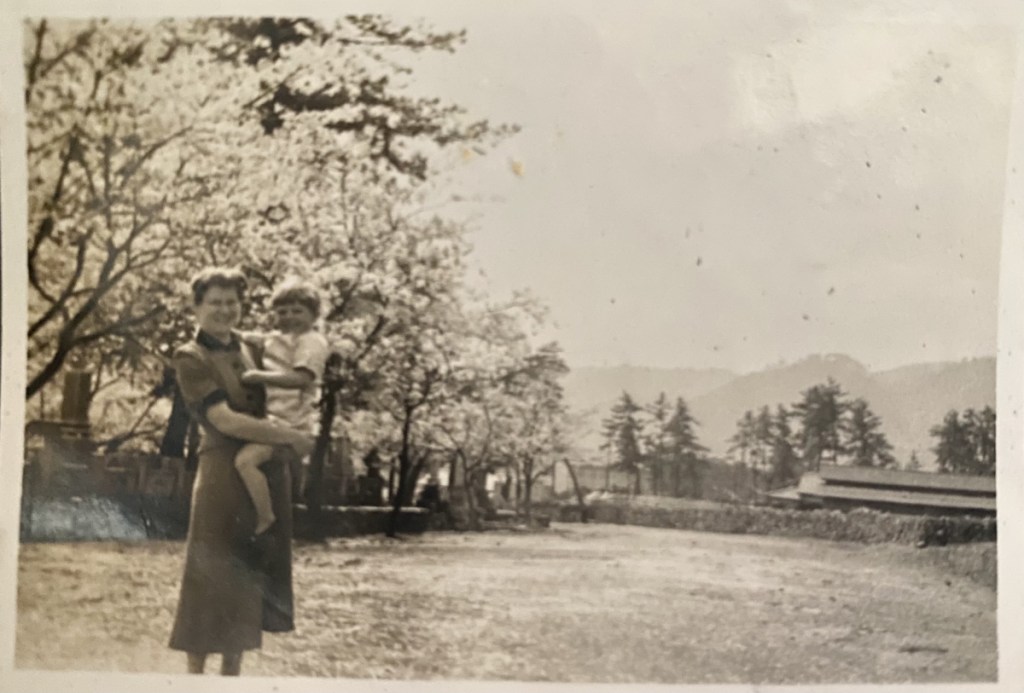
The last blog post chronicled how June & Milton felt led to move south/west to Kyushu and miraculously received money to pay for the trip just at the right time. This next story takes place starting on April 5th 1949 when they start the long train journey. This was long before the comfortable and speedy modern trains that Japan is now known for. They each chronicled this train trip in their autobiographies, so clearly it left an indelible memory for both of them.
Milton: The war years had eaten up any hope of luxury for Japanese. The National Railways realistically categorized the creaking dull brown carriages with just 2nd class or 3rd class. We bought 3rd class tickets to save money. One senior missionary warned us, “If you insist on going 3rd class, get to the station hours ahead of time. There are a lot of people wanting to travel.” We never managed to arrive anywhere hours early, but we tried and made it 45 minutes before the train was to leave.
June: Bobby Wright was there to see us off. He said, “How come you arrive so late. People have been standing in line for hours to get on this train.”
Milton: When we squeezed our way up onto the platform, our eyes boggled. Not only was every carriage full, but the platform itself was packed. We had a lot to learn. I left June and little Stan with the baggage and ran down to the end of the train in a vain effort to find a place. I thought that surely if God had brought us thus far, He could make a hole in all this humanity for us. I saw nothing but people.
June: I was shocked but stood in a long line of waiting people holding baby Stanley. A conductor came along and very kindly asked me to follow him. There was a place for conductors on each carriage separated by a door from the rest of the carriage. It even had a table as well as seats.
Milton: So, I shoved and squirmed my way back to where I had started. June and the baby had disappeared. I pushed up to the side of the carriages and slowly searched each entrance. I found June happily seated at a tiny table by a door. “The conductor saw us and offered us his seat. He said he wouldn’t get to sit down anyhow with all these people to care for,” June explained. We had a seat for June and a place to keep Stan’s bottles all the way to Kobe.
God was edging us along gently; taking us further out to show us some breathtaking things.
Mary: In Dad’s diary there was this additional note: “Stan behaved amazingly – not one wet or dirty nappy – we arrived in Kobe at 8:00 am to be met by Brother & Sister Ishihama.” So they spend a night in Kobe before they move on.
June: After his wife served us a meal, he took us to the bathhouse. It was a common bath for everyone who paid a small fee. Most Japanese used the public bath house. In those days very few had a private bath in their home.
Milton: Inside the bathhouse we saw a lady facing us, sitting perched up high in the middle of the entrance room with her back to the wall. She took money from the left and right. The door on the right was for the males and the one on the left was for the ladies. She could turn and answer any questions from either dressing room through the window at her back by simply turning her head.
June: I found it embarrassing to undress in front of others as I was the only non-Japanese. Following the example of the others in the bathhouse I washed and rinsed myself before getting into the bath. I got in but felt as though I was being burnt by the hot water. It was about 40 degrees centigrade. I got straight out. At least I was clean.
Milton: It seemed that all the built-in taboos of exposed skin vanished inside a formal bathhouse. As does status. It was probably the only place in Japan where men could be moving and talking without worrying about protocol and status.
The next day Mr. Ishihama took me on a guided tour to the famous Shinkaichi Mission Hall. Then we caught the train for Kokura. We were on our own. God was taking the props away and had brought us through with a display of care and timing that amazed us and He had only just begun.
And also from his diary the evening they left Kobe for Kokura: “Traveling from Kobe is crowded and difficult. We decided to leave on the 8:10 pm train. Last time I went there was standing room only. We boarded the train – there were two seats diagonally opposite. We took them. Immediately a man from one seat next to mine rose and took another seat further away, making room for Stan! Then a man near June left and found another seat. Even in a 3rd class car we had seats all the way. Praise God.
Mary: I wasn’t sure why Dad referred to the Shinkaichi Mission Hall as “famous”. Some Internet searching gave some references to a mission hall built at the turn of the century and associated with the Japan Evangelistic Band. Interestingly, much later, June & Milton would end up joining this same group (a future story). For train fans: I did a little checking and the first “Shinkansen” known as the “Bullet Train” had its first run just 15 years after this story, in 1964. That was a rapid modernization of their train system! Today, the trip from Tokyo to Kobe only takes 2 1/2 hours.
In future post, Milton will narrate how they came to move to the city of Beppu and manage to buy a small house. I am pretty sure the picture below was taken in that house.

This image looks so wonderfully traditional I had to refresh my memory on some of the Japanese terms in this photo. Although there is a throw rug on the floor, underneath that you can see the tatami mat flooring. The alcove (tokonoma) behind them was typical for Japanese houses. It was a place for a hanging scroll (Kakemono or also Kakejiku) and usually a flower arrangement. Seeing the flowers in the picture reminded me how years later in Tokyo, Mom asked a lady from the church to teach her the Japanese flower arranging style “Ikebana“. Thanks to Dave who translated the scroll for me as my Kanji character knowledge is almost nonexistent. It says in Japanese: “God is love.”


Love reading these stories. Fabulous 🤩
LikeLiked by 1 person
Thank you !
LikeLike